Welcome!
Please, enjoy our completely free circuit diagrams and electronics projects database!














Random circuits
Here are some of over 800 projects from our free circuit diagrams database. For more, try browsing categories menu on the left.
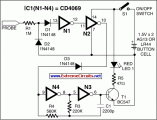 Portable loads such as video cameras, halogen flood lights, electrical irons, hand drillers, grinders, and cutters are powered by connecting long 2- or 3-core cables to the mains plug. Due to prolonged usage, the power cord wires are subjected to mechanical strain and stress, which can lead to internal snapping of wires at any point. In such a case most people go for replacing the core/cable, as finding the exact location of a broken wire is difficult....
[read more]
Portable loads such as video cameras, halogen flood lights, electrical irons, hand drillers, grinders, and cutters are powered by connecting long 2- or 3-core cables to the mains plug. Due to prolonged usage, the power cord wires are subjected to mechanical strain and stress, which can lead to internal snapping of wires at any point. In such a case most people go for replacing the core/cable, as finding the exact location of a broken wire is difficult....
[read more]
 Using this low-cost project one can reproduce audio from TV without disturbing others. It does not use any wire connection between TV and Loud Speaker. In place of a pair of wires, it uses invisible infra-red light to transmit audio signals from TV to Loud speakers, Without using any lens a range of up to 6 meters is possible. Range can be extended by using lenses and reflectors with IR sensors comprising transmitters and receivers....
[read more]
Using this low-cost project one can reproduce audio from TV without disturbing others. It does not use any wire connection between TV and Loud Speaker. In place of a pair of wires, it uses invisible infra-red light to transmit audio signals from TV to Loud speakers, Without using any lens a range of up to 6 meters is possible. Range can be extended by using lenses and reflectors with IR sensors comprising transmitters and receivers....
[read more]
 In all the houses exist the bells in the door. All want, they have the possibility of being possible to change the intensity, the tone of sound. With this circuit we have this possibility. With the materials round the gates, we can change the sound....
[read more]
In all the houses exist the bells in the door. All want, they have the possibility of being possible to change the intensity, the tone of sound. With this circuit we have this possibility. With the materials round the gates, we can change the sound....
[read more]
 This Keypad is suitable for the Modular Burglar Alarm. However, it has other applications. Pressing a single key will energize the relay. Entering the Four-Digit code of your choice will de-energize it....
[read more]
This Keypad is suitable for the Modular Burglar Alarm. However, it has other applications. Pressing a single key will energize the relay. Entering the Four-Digit code of your choice will de-energize it....
[read more]
 Do you long for a beach holiday on a tropical island, but you don’t have the necessary wherewithal? We’ve got just the answer: build the i-TRIXX surf simulator, put on your headphones, and dream yourself away from this dreary realm. Let the rhythmic rush of the waves transport you to a sun-drenched beach with gently swaying palm trees, and relax for a while before returning to a chilly confrontation with reality. That’s the ultimate in low-budget travel....
[read more]
Do you long for a beach holiday on a tropical island, but you don’t have the necessary wherewithal? We’ve got just the answer: build the i-TRIXX surf simulator, put on your headphones, and dream yourself away from this dreary realm. Let the rhythmic rush of the waves transport you to a sun-drenched beach with gently swaying palm trees, and relax for a while before returning to a chilly confrontation with reality. That’s the ultimate in low-budget travel....
[read more]
 The circuits light a 20 watt lamp when the contacts are touched and the skin resistance is about 2 Megs or less. The circuit on the left uses a power MOSFET which turns on when the voltage between the source and gate is around 6 volts. The gate of the MOSFET draws no current so the voltage on the gate will be half the supply voltage or 6 volts when the resistance across the touch contacts is equal to the fixed resistance (2 Megs) between the source and gate....
[read more]
The circuits light a 20 watt lamp when the contacts are touched and the skin resistance is about 2 Megs or less. The circuit on the left uses a power MOSFET which turns on when the voltage between the source and gate is around 6 volts. The gate of the MOSFET draws no current so the voltage on the gate will be half the supply voltage or 6 volts when the resistance across the touch contacts is equal to the fixed resistance (2 Megs) between the source and gate....
[read more]